Understanding The Financial Statements
Learn which financial statements reveal hidden profit leaks and better business decisions. Understanding financial statements is one of the most important skills you can build as a home service business owner, and I know that sounds about as much fun as a truck breaking down on a Friday afternoon.
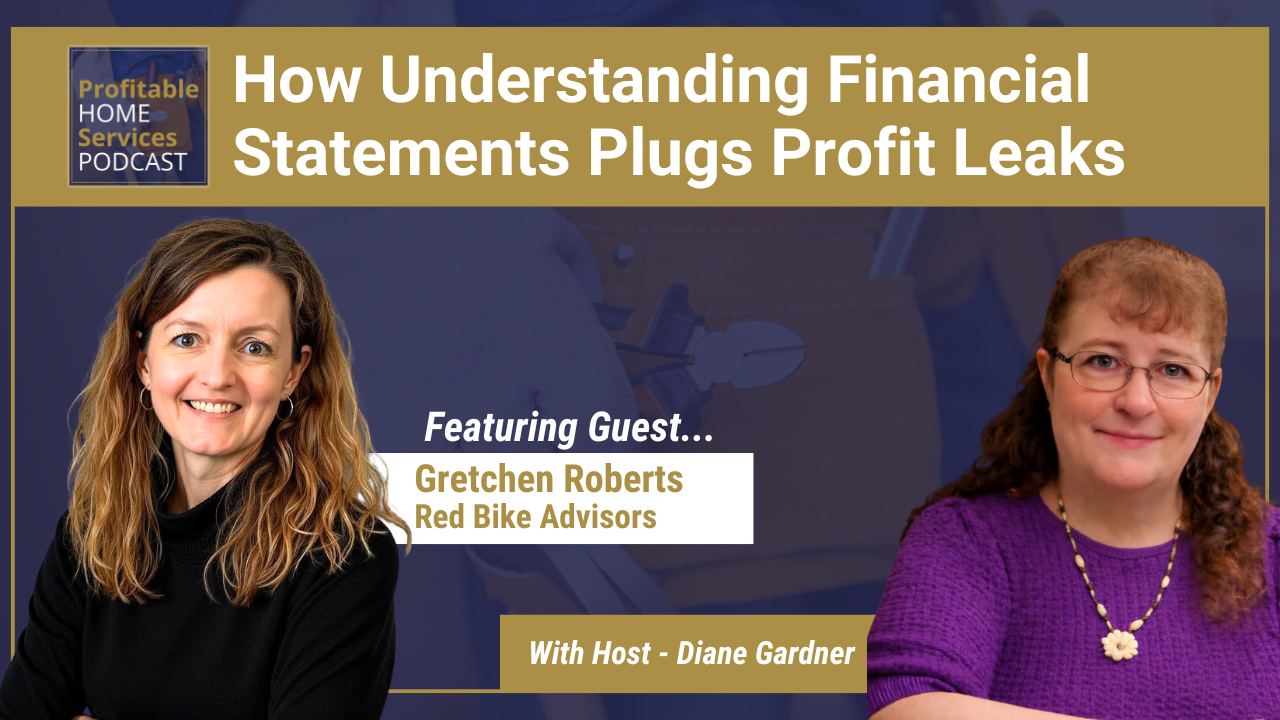
In this episode, I’m joined by Gretchen Roberts, CEO of Red Bike Advisors, a tax, accounting, and advisory firm that works with home service businesses all across the country. Gretchen has a gift for making numbers feel like a conversation instead of a lecture, and she brings that same energy here as we dig into profit and loss statements, cost of goods sold, expense ratios, and the real reason your bank account never quite matches your net profit.
I actually had a customer years ago who was running four service lines and throwing everything into one bucket, and it wasn’t until we broke those numbers out that we discovered one line was silently eating the profits of the others, which is exactly the kind of thing Gretchen and I want to help you catch before Sneaky Leaky drains another year of your hard work.
What You’ll Learn…
- Why understanding financial statements starts with clean, up-to-date books
- How to know whether your cost of goods sold number is actually telling the truth
- What expense ratios reveal about where your profits are going each month
- Why understanding financial statements monthly creates patterns you can act on
- The real reason your bank account doesn’t match your net profit at year’s end
- How separating revenue by service line can expose a profit drain you didn’t know existed
- What pricing has to do with profit, and why not raising your rates is costing you money
Key Moments…
[0:45] Why Clean Books Are The Foundation Of Understanding Financial Statements
[5:10] How To Know If Your Bookkeeper Is Actually Doing A Good Job
[9:30] Cost Of Goods Sold Versus Overhead And Why The Difference Matters
[14:15] How Expense Ratios Help You See Where Your Money Is Really Going
[19:00] Why Understanding Financial Statements Means Looking Beyond Your Bank Balance
[24:30] How Breaking Revenue Into Service Lines Reveals Hidden Profit Drains
[29:45] The Owner Salary Problem And Why It Skews Your Cost Of Goods Sold
[34:20] What The Profit Time Index Tells You About Working “In” Versus “On” Your Business
[38:50] Expenses Below The Bottom Line That Explain Where Your Profit Went
[43:30] Why Not Raising Your Prices Every Year Is A Profit Leak You Cannot Afford
[46:15] Where To Start When You Want To Find And Fix Your Profit Leaks Today
Why Clean Books Are The Foundation Of Understanding Financial Statements
You can’t make good decisions from bad data, and that’s exactly what happens when your books are behind or categorized incorrectly. Understanding financial statements only works when the numbers feeding into them are clean and current. A lot of home service business owners hand their books off and assume no news is good news. But if nobody’s checking the details, Sneaky Leaky is in there quietly doing damage. Clean, up-to-date books are the starting point for everything else.
How To Know If Your Bookkeeper Is Actually Doing A Good Job
Most owners don’t know what good bookkeeping looks like, and that’s not a knock on you; it’s just not your trade. Understanding financial statements requires trusting the numbers behind them, so who’s keeping your books really does matter. Gretchen’s firm does what they call an “under the hood” review to check whether expenses are categorized, accounts are reconciled, and balance sheets are current. If those basics aren’t happening, your reports aren’t telling you the truth. Find someone you trust and make sure they’re delivering clean books every single month.
Cost Of Goods Sold Versus Overhead And Why The Difference Matters
Putting expenses in the wrong category is one of the most common mistakes I see, and it throws off everything else on your P&L. Understanding financial statements means knowing that what it costs to deliver your service belongs in Cost of Goods Sold, not mixed in with your overhead. Gretchen sees it constantly: crew payroll, trucks, tools, and uniforms sitting in the wrong bucket. When that happens, you can’t benchmark against industry standards, and you don’t know which lever to pull. That’s where Sneaky Leaky hides, right inside a misclassified line nobody’s looking at.
How Expense Ratios Help You See Where Your Money Is Really Going
Grouping your numbers into buckets, such as revenue, cost of goods sold, operating expenses, and profit, is what makes understanding financial statements actually useful. Each bucket should represent a certain percentage of your total revenue, and when one of those percentages is off, you know where to look. Gretchen calls these your levers, and once you know which one is out of line, you know what to fix. If your cost of goods is too high, you look at pricing, efficiency, and what your crew is spending on company cards. This is how you go from guessing to knowing.
Why Understanding Financial Statements Means Looking Beyond Your Bank Balance
Checking your bank balance to run your business is one of the most common profit drains I see. Understanding financial statements means knowing that your net profit number and your bank balance are two different things for real reasons. Gretchen breaks it down into four buckets that come out below the bottom line: loan principal, taxes, cash savings, and reinvestments. None of those show up as expenses on your P&L, but they absolutely come out of your cash. Once you know where to look, that gap stops being a mystery.

How Breaking Revenue Into Service Lines Reveals Hidden Profit Drains
If you offer more than one type of service and you’re throwing all the revenue into one bucket, you don’t actually know what’s profitable. Understanding financial statements at the service line level is what gives you that clarity. I had a customer running four service lines who couldn’t figure out why profits were soft. When we finally broke the numbers out, one line was eating the profits of the other three. He closed that line, and the whole business got healthier almost immediately.
The Owner Salary Problem And Why It Skews Your Cost Of Goods Sold
If you’re still in the truck part of the time, that portion of your pay needs to sit in Cost Of Goods Sold, not all lumped into one salary line. Understanding financial statements accurately means treating your own time the same way you’d treat any other employee’s time. Gretchen sees owners paying themselves a small salary for tax reasons while doing fieldwork that would cost real money to replace. That makes Cost Of Goods Sold look artificially low and gives you a false read on job profitability. Split your salary the way you split your time, and your numbers will tell a much truer story.
What The Profit Time Index Tells You About Working In Versus On Your Business
Gretchen shared a tool called the profit time index that measures how much time you spend working in your business compared to the profit you actually have. Understanding financial statements is one thing, but this exercise shows you whether your time is generating a real return. A lot of owners stay in the truck because it feels productive, and it is, just not in a way that builds a scalable business. When the time you spend and the profit you keep don’t line up, something needs to change. This is the kind of clarity that turns a busy owner into a real CEO.
Expenses Below The Bottom Line That Explain Where Your Profit Went
One of the most confusing moments for any owner is seeing a strong net profit number and wondering where all that money actually went. Understanding financial statements means knowing there are real expenses that come out after that net profit line: loan principal, taxes, cash savings, and reinvestments. None of those show up as line items on your P&L, but they absolutely come out of your pocket. I had a customer who thought spending down the net profit number at year’s end would save them on taxes, and it wiped out their operating budget for months. Once you know what lives below the bottom line, that confusion goes away.
Why Not Raising Your Prices Every Year Is A Profit Leak You Can Not Afford
Every expense in your business goes up every year: labor, materials, insurance, fuel, etc. If your prices aren’t keeping pace, your margin shrinks whether you notice it or not. Understanding financial statements makes this visible because you can see the compression happening in real numbers. Gretchen recommends raising prices every single year, and her coach puts the minimum at 20% to stay ahead of inflation and rising costs. If that number makes you nervous, start by raising rates for new customers only. They don’t know what you charged before, and that one move drops straight to your bottom line.
Where To Start When You Want To Find And Fix Your Profit Leaks Today
Don’t try to fix everything at once. Understanding financial statements gets easier the more often you look at them, so start with monthly reviews and let the patterns show themselves over time. Gretchen says the biggest lever is almost always Cost Of Goods Sold, so get everything in the right bucket first and then drill down from there. Even small improvements compound fast: a 5% increase in gross profit can add 30 to 50% more to your bottom line over time. Start small, stay consistent, and keep Sneaky Leaky out of your numbers for good.
Profitable Home Services Podcast helps home service owners build a profitable home service business through stronger financial systems, better operations, healthier cash flow, smarter pricing, and sustainable growth. Diane Gardner shares practical strategies to improve home service profits, protect contractor profits, and create owner freedom through better business decisions.
About Gretchen Roberts:
I’m Gretchen Roberts, CEO of Red Bike Advisors, a national tax, accounting, and advisory firm that partners with healthcare and professional service businesses seeking proactive, strategic financial guidance. Since 2009, I’ve helped hundreds of practice owners—dentists, medical providers, chiropractors, therapists, veterinarians, and alternative medicine practitioners—simplify their finances, reduce taxes, improve profitability, and build businesses that create real wealth.
As a multi-time entrepreneur, I understand the financial pressure healthcare owners face. I blend an operator’s mindset with deep expertise in healthcare finance, tax strategy, profitability optimization, and exit planning. My mission is to give business owners clarity, control, and confidence through proactive financial insight—not reactive accounting.
Connect With Gretchen:
Visit Gretchen’s Website
Connect with Red Bike Advisors on LinkedIn
Follow Gretchen on LinkedIn
Diane’s Resources:
15 Profit Leaks Report
📖 Spot the common places where money slips out of a service business and learn the fixes that keep more cash with you. https://profitcoach4you.com/profitleaks
Profit Impact Call
☎️ Get a live review of your numbers so you can see where profit is leaking and walk away with a plan to save thousands. https://taxcoach4you.com/profitimpactcall/
Schedule a free Profit Impact Call with me where we’ll go over 12 main areas of your business together and save you $45k!